Marginalia: comments on the sides


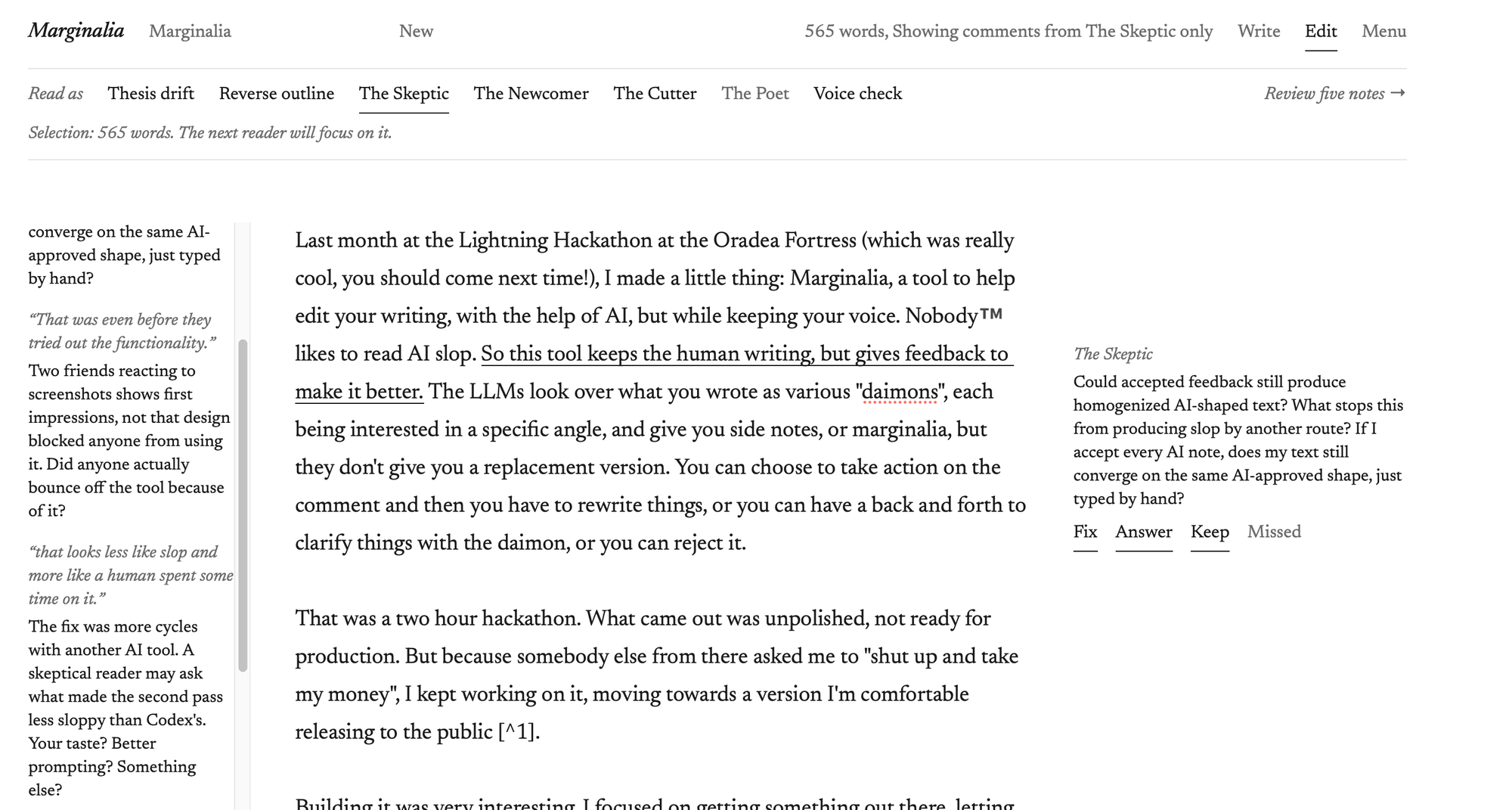
Last month at the Lightning Hackathon at the Oradea Fortress (which was really cool, you should come next time!), I made a little thing: Marginalia, a tool to help edit your writing, with the help of AI, but while keeping your voice. Nobody™️ likes to read AI slop. So this tool keeps the human writing, but gives feedback to make it better. The LLMs look over what you wrote as various "daimons", each being interested in a specific angle, and give you side notes, or marginalia, but they don't give you a replacement version. You can choose to take action on the comment and then you have to rewrite things, or you can have a back-and-forth to clarify things with the daimon, or you can reject it.
That was a two hour hackathon. What came out was unpolished, not ready for production. But because somebody else from there asked me to "shut up and take my money", I kept working on it, moving towards a version I'm comfortable releasing to the public [^1].
Building it was very interesting. I focused on getting something out there, letting Codex do a basic design. But the very first feedback that I received, from two friends: "this looks like AI slop". That was even before they tried out the functionality. AI slop design turns out to be an impediment for actually using it, so I had to go back, spend some more cycles with Fable until we got a nice design out, that looks less like slop and more like a human spent some time on it.
How does it work?
When you write, you get a blank screen. Minimal distractions, so you can focus on writing your own words. A single daimon is available here: "I'm stuck", that gives you a list of questions to prompt you what to write going forward.
When you are done writing, you switch over to edit mode, and there you have 7 daimons:
- Thesis drift: it warns you if your opening, main point and ending don't line up
- Reverse outline: summarizes each paragraph you wrote, so you can compare the structure you intended with what you wrote
- The Skeptic: asks the tough questions - challenging unsupported claims, gaps in logic, suggests potential counterarguments
- The Newcomer: is someone outside your field, points out missing context, jargon, or where things become too dense
- The Cutter: tells you where there are redundancies, things to cut
- The Poet: you select something and it gives you suggestions that would make it sound better
- Voice check: you can build up a style profile by giving it examples of past writings and it will tell you if you're off
Marginalia reviews itself
On this blog post, this is some of the feedback that I received:
- The Newcomer didn't understand its own description. Initially it was
“The Newcomer: has no idea what’ going on, probes you like it encounters this the first time in his life”.
So it gave the following feedback:
“This is the one entry that reads confusingly. It describes a persona, not what it does for my text. Does it flag jargon and missing context? Also, there’s a typo (‘what’’).”
- Thesis drift caught that I initially didn't include the name of the tool until the very end:
“This is the first time the product is named. In ¶1 ‘marginalia’ is only a lowercase description of side notes. A reader may not realize until ¶9 that this is the tool’s name.”
- Thesis drift also questioned the paragraph about the design, saying it doesn't really belong. But I didn't agree with it, I think it's an observation that is worth including.
- The Skeptic highlighted something interesting (visible in the screenshot at the top): Could even just giving feedback still eventually lead to slop, but by another route? I guess that's the question I'll be exploring.
None of these write for you (with the exception of The Poet, which does recommend actual phrases). You'll get comments on the side, and it's up to you to decide what to do with them. That's Marginalia: feedback from different perpectives, while leaving the writing to you.
I had great fun building it. I'm still exploring ways to make the feedback more relevant. If this caught your eye, give it a try, I'd love to hear from you.
[1]: Although only with a waitlist.